
Consumer 3C Electronics
Laser Cutting and Drilling of Complex 3C‑Electronic Glass Components
Built for complex 3C glass components: non‑contact ultrafast laser machining delivers micron‑level contour accuracy and flawless micro‑hole quality. From intricate special‑shaped profiles to high‑volume deliveries, industrial‑grade stability perfectly meets the stringent high‑quality requirements of 3C consumer electronics.

Why Ultra‑Fast Laser Machining Enters a Critical Phase for 3C Manufacturing
As glass becomes thinner, smaller and structurally more complex, the limitations of conventional processing methods become increasingly prominent. Smartphones, foldable displays, wearables and advanced packaging continuously push glass toward thinner, more complex and higher‑precision designs. It requires machining of micro‑holes and free‑form curved surfaces while maintaining processing consistency for high‑volume production.
Driven by maturing ultra‑fast laser sources, optics and automation technologies, ultra‑fast laser processing is evolving from “lab‑based technology” to industrial‑scale manufacturing. Technological progress is not driven by equipment alone. Upgraded 3C products create brand‑new cutting and drilling demands, further accelerating the industrial adoption of ultra‑fast laser cutting and drilling. Covering from individual components to full production workflows, CKD integrates laser sources, optical systems, motion control and vision systems to deliver complete, production‑ready laser cutting and drilling solutions.
Key Capabilities
- High Precision: Contour and hole‑position tolerance ±5‑20 μm, meets standard 3C manufacturing requirements
- Low Damage: Chipping controlled ≤10 μm, greatly reduces micro‑cracks and fragment defects
- Complex Geometry: Process special contours, curved profiles and micro‑holes
- Process Integration: Combined cutting, drilling and dicing within one system
- Automation Ready: Vision‑guided positioning for automated 3C mass‑production lines
Production Benefits
- Yield improvement by 10‑15 percentage points
- 30 % lower overall costs
- 40 % reduction in labour requirement
为什么现在是超快激光 进入 3C 加工的关键阶段?
3C 产品正在重新定义玻璃加工
当玻璃变得更薄、更小、结构更复杂,传统加工手段的局限性日益凸显。智能手机、折叠屏、可穿戴设备及先进封装持续推动玻璃往薄型化、复杂化、高精度方向迭代,传统机械加工已难以为继。
UTG、显示玻璃厚度持续降低至 0.1 mm 以下,机械加工极易产生崩边、裂纹、隐裂
异形轮廓、曲线、摄像头孔、传感器孔应用急剧增多,普通刀具无法胜任
微孔、微槽高密度微结构加工,对孔径精度 ± 5 μm、位置一致性要求严苛
消费电子 7×24 连续批量生产,对加工稳定性、良品率与自动化能力要求极高
超快激光走向工业化
超快激光器、光学与自动化技术日趋成熟,推动超快激光走出实验室,落地消费电子、微电子、精密玻璃加工等工业领域。CKD 实现从单一部件到完整产线的整体方案,整合激光源、光学系统、运动控制与视觉系统,提供可直接投产的激光切割钻孔整套解决方案。
脉冲极短(皮秒 / 飞秒级),热影响区 < 2 μm,玻璃边缘无微裂纹、无崩边
纯软件控制,切换新产品无需重新开模,仅需载入 CAD/DXF 图纸,NPI 周期缩短至数小时
运动平台精度 ± 1 μm,激光束定位精准,大批量生产参数锁定、加工一致 整线交钥匙能力
CKD 整合激光源、光学系统、运动控制与视觉系统,提供可直接投产的完整设备方案
Laser Cutting & Drilling Machining of Typical 3C Electronic Components
- Mobile phone cover glass & mobile phone back cover contour glass
- Mobile phone camera protector glass
- Mobile phone tempered film glass, ultra‑thin screen protection glass
- Sapphire glass (for wearables, lenses, touch‑control lenses)
- Smart watch watch‑face glass (round, special‑shaped, curved)
- Protective glass for tablets and laptops
- Display panel glass for industrial control equipment
- Touch‑control glass lens for Bluetooth earphone cases
- Camera lens optical filters, ultra‑thin optical glass dicing
平板玻璃、异形玻璃、超薄玻璃全切 / 半切 / 划片,激光划线与裂解一体化方案,无接触加工、边缘无崩边。
- →手机屏幕盖板玻璃外形切割
- →手机后盖玻璃异形裁切
- →手机摄像头保护片玻璃切割
- →手机钢化膜、超薄屏幕防护玻璃
- →蓝宝石玻璃(穿戴设备、镜头、触控镜片)
- →智能手表表镜玻璃(圆形、异形、曲面)
- →平板、笔记本电脑防护玻璃
- →蓝牙耳机仓触控玻璃镜片
- →摄像镜头滤光片、光学超薄玻璃划片
- Front / rear camera lens holes for mobile phones
- Precision openings for mobile phone earpieces and speakers
- Micro‑holes for under‑display fingerprint sensor arrays
- Tiny sensing holes for smartwatch blood‑oxygen and heart‑rate detection
- Micro‑acoustic holes for Bluetooth earphone sound pickup
- Locating & assembly fixing micro‑holes for lens glass
- Various micro venting & light‑transmission array holes for 3C optical glass
微孔、通孔、摄像头孔、传感器孔、阵列孔,最小孔径 Ø 0.05 mm,孔型规则、孔壁光滑、无热损伤。
- →手机前置 / 后置摄像头镜头孔
- →手机听筒、扬声器精准开孔
- →屏下指纹传感器阵列微孔
- →智能手表血氧、心率感应小孔
- →蓝牙耳机收音、拾音微型孔
- →镜头玻璃定位、装配固定小孔
- →各类 3C 光学玻璃透气、透光阵列孔
- →可穿戴设备传感器密封小孔
CKD Laser Equipment 3C Electronics Cutting & Drilling Samples
Our laser systems excel at cutting and drilling for 3C consumer electronics, delivering clean, precise results with stable dimensional accuracy for delicate electronic parts, ideal for high‑volume manufacturing.

材质蓝宝石玻璃
High-quality contour cutting for automotive instrument panels.
CKD 设备对应解决方案
设备可兼容多规格 3C 玻璃工件,兼顾小批量试样与大规模量产。如需了解设备参数,欢迎联系我们的技术团队。
加工测试示例
提供您的 DXF / DWG / PDF 图纸,我们 3–5 个工作日内出具实际样品与工艺报告。
整机解决方案特点
消费电子 7×24 连续批量生产,对加工稳定性、良品率与自动化能力要求极高
高精度扫描振镜 + 远心场镜,支持大幅面均匀加工,光束质量 M² < 1.3
消费电子 7×24 连续批量生产,对加工稳定性、良品率与自动化能力要求极高
视觉系统 CCD 自动对准,边缘检测与实时品质监控,首件自动确认
自研工控软件,DXF/DWG 直接导入,产品切换无需停机,参数快速锁定
支持 MES 系统对接,可配机械臂自动上下料,实现无人化连续生产
案例或实际加工场景
完美的一次切割,钻孔视频展示
在最近的一个项目中,我们的团队将普通的卫生间标识牌改造成了精致醒目的设计。我们利用专为激光应用而设计的Rowmark塑料,以及配备150瓦激光管(功率设置为20%,速度设置为300毫米/秒)的Boss HP2440激光切割机,将我们的创意变为现实。从简洁流畅的设计到醒目亮丽的标语,我们的卫生间标识牌充分展现了创意与尖端激光技术相结合的无限可能。

图片或视频







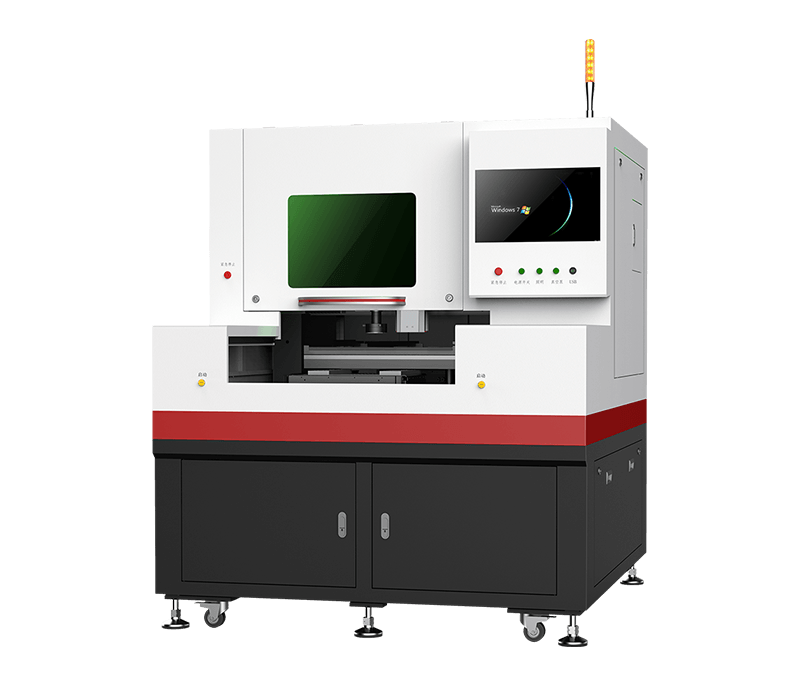
Recommended Laser Machines
This green picosecond laser glass cutting machine works with an extensive range of 3C glass workpieces, supporting small‑batch sampling as well as high‑volume mass production. Please see the product detail page for full equipment specifications.
3C‑Electronic Glass Cutting & Drilling | Common FAQs
Absolutely not. As a non‑contact cold‑processing technology, the ultrafast laser features ultra‑short pulses with heat‑affected zone <2 μm, removing material at molecular level. It will not burn screen‑printing ink and prevents AF coating edges from peeling or chipping, complying with high‑standard cosmetic inspection.
Highly flexible. As a digitally‑controlled processing solution operated purely by software:
Zero tooling costs: No new molds needed for product change‑overs. Simply load new CAD/DXF drawings and adjust the beam path.
Rapid NPI roll‑out: Sampling and process validation can be finished within hours, greatly accelerating R&D and time‑to‑market for new 3C mass‑production products.
- The optical path of the equipment is calibrated regularly to ensure positioning accuracy of the motion platform.
- Parameters are tuned for micro‑hole processes to control single‑pulse energy output.
- Temperature is strictly controlled in the processing environment to minimize dimensional drift caused by thermal deformation.
- Aperture dimension inspection is performed on the first article, with periodic sampling inspections during mass production.
It depends on the end‑product requirements for drop resistance and bending strength.
For most internal structural parts, micro‑holes and general special‑shaped profiles, no secondary mechanical grinding or polishing is needed after laser processing. Parts can go directly to cleaning or assembly.
For cover glass or foldable‑display UTG with high‑stress and high drop‑resistance requirements, only mild chemical strengthening or rapid etching is required after laser processing to achieve excellent bending and impact resistance, significantly shortening the overall process chain.